About CTLSI
The Comprehensive Trauma Life Support (CTLS) course is a multidisciplinary trauma training course aimed primarily at doctors.
International Trauma Care (ITACCS) and International Trauma Care (ITACCS) Indian Chapter have collaborated to provide the course in India.
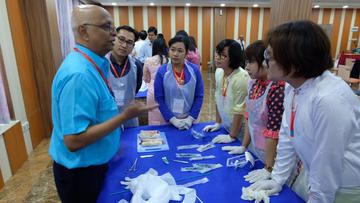
CTLS course is an authentic course on acute trauma management being organized in India. The CTLS course runs over two days, and has a course manual (provided pre-course), 26 interactive case-based discussions, practical skill stations, a pre-test and in-course testing.
International and Indian national faculty continuously review and revise the manual and presentation materials to ensure they reflect contemporary practice that is applicable to the Indian environment. The emphasis is on a multi-disciplinary team and evidence-based approach to trauma management in India.
Curriculum
While there is much that can be done to prevent trauma in terms of speed restriction, alcohol, seat belt, child restraint and helmet use, there will always to be need for rapid effective trauma assessment and management.
Many patients can be saved or suffer less disability of the time to achieve definitive care of their injuries can be minimized. This require a trauma system approach, which refers to the integration of all aspects of trauma care to achieve best outcome.
Population on based evidence supports a 15 to 20% improved survival rate among seriously injured patients with trauma system implementation.
The course will emphasize:
- Assessment / management, Team role and preparation
- Primary survey, simultaneous resuscitation and re-evaluation
- Planning and definitive care management
- Ongoing support to optimize outcome
Target Audience
- Anaesthesiologists
- Emergency Physicians
- Critical Care Physicians
- General Surgeons
- Neuro-Surgeons
- Orthopedic Surgeons
- Plastic Surgeons
- Pediatric Surgeons
- Obstetrician & Gynecologists
- Facio-Maxillary Surgeons and
Doctors from other speciality who are involved in Trauma Care
Program Schedule
Day 1
| 07:30 | Registration |
| 08:30 | Course Overview |
| 09:00 | Initial Assessment & Primary Survey |
| 09:50 | Airway Assessment & Mangement |
| 10:40 | Coffee Break |
| 11:00 | Workshop : Interosseous/ Chricothyrotomy |
| 12:00 | Haemorrhage Assessment & Management |
| 12:50 | Lunch |
| 13:30 | Severe Head Injury |
| 14:20 | Abdominal Trauma |
| 15:00 | Coffee Break |
| 15:30 | Thoracic Trauma |
| 16:20 – 17:30 | Workshop : Airway / RSI / Chest Tubes |
Day 2
| 08:30 | Spinal Trauma |
| 09:10 | Musculoskeletal Trauma |
| 10:00 | Burns |
| 10:40 | Break |
| 11:00 | Trauma in Pregnancy & Children |
| 11:50 | The Elderly Trauma Patient |
| 12:30 | Lunch |
| 13:30 | Definitive Care |
| 14:10 | Transport of the critically injured |
| 14:50 | Break |
| 15:10 | Intensive Care : The First 24 hours |
| 16:00 – 17:00 | Evaluation & Concluding Session |
Since 2005 more than 32 courses have been conducted in centers including Chennai, Bengaluru, Cochin, Agra, Coimbatore, Chandigarh, New Delhi, Hyderabad, Shillong, Bhubaneshwar, Ludhiana in India. I additional recently Indian faculty have been invited to conduct the course in Assisut, Egypt and Yangon, Myanmar. Currently more than 2100 clinicians have been trained in CTLS.
Through judicious planning and implementation through the national CTLS coordinator the costs of running the course have been minimized to facilitate registration fees of INR 6000 to 8000 per delegate.
India has a population of more than a billion people and one of the world’s highest death rates from major trauma. There is great need for trauma education and CTLS is a valid course to assist in that process.
Latest Programs
Chandigarh CTLS 2023 (Provider Course) Program Schedule (View)
Gallery